
Cashew Grades
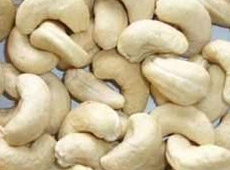
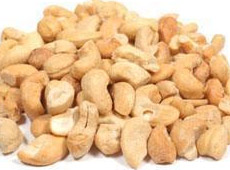
Cashew Kernels are graded into white / scorched wholes, splits, butts etc. Depending on the shape, size & colour of the kernel. There are various different grades of cashew kernels, but few grades are commercially available and traded. They are:
- W - 180, is the 'King of Cashew' - They are larger in size and very expensive.
- W - 210, are popularly known as 'Jumbo' nuts.
- W - 240, it is an attractive grade which is reasonably priced.
- W - 320, are the most popular among cashew kernels and highest in terms of availability, worldwide.
- W - 450, are the smallest and cheapest white whole kernels and hence the favorite among low priced whole grades.
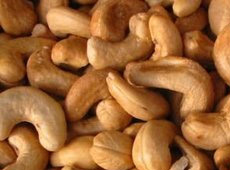
Scorched wholes are another grade of cashew kernels, which have a slight brown colour due to longer roasting. They have all the other characteristics of white kernels and have the same nutritional qualities.
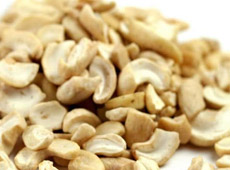
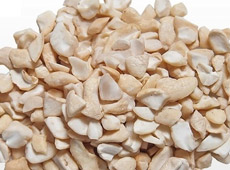
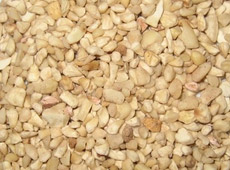
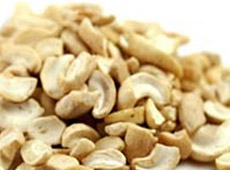
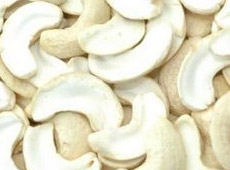
Butts, splits and pieces are priced lower and are ideal for cooking, preparation of sweets and savoury snacks.
| Grades | Types |
|---|---|
| White Wholes(WW) | WW-180, WW-210, WW-240, WW-320, WW-450, WW-500, Large White Pieces(LWP), Small White Pieces(SWP), Butts, Splits |
| Scorched Wholes(SW) | SW, SW-180, SW-210, SW-240, SW-320, SW-450, SW-500, Scorched Splits(SS), Scorched Pieces(SP), Large Scorched Pieces(LSP), Scorched Small Pieces(SSP) |
Common Packing For Container Shipment
Nuragri-Expo packs the cashew in the following options, these are now the most preferred packing by most of our buyers.
- Two flexi packs of 25lbs each in a carton for a total of 50lbs.
- 700-750 such cartons make a full container load.
The other mode of packing Nuragri-Expo does is Two 'KO' type tins of 25lbs each in a carton for a total of 50 lbs. 700 such cartons make a full container load.
For the Middle East Nuragri-Expo also packs in 10Kg tins, in which case two such tins are packed in a carton for a total of 20Kgs. 750 such cartons make a full container load. Full container load is preferred as it results in huge saving in ocean freight.
| Packing | In 20' Full Load Containers |
|---|---|
| In 2 x 10 kgs vaccumised tins in cartons | 700 cartons |
| In 2 x 25 lbs (11.34 kgs) vaccumised tins in cartons | 700 cartons |
| In 1 x 50 lbs (22.68 kgs) vacuum flexy pouches in cartons | 700 cartons |
| In 2 x 25 lbs (11.34 kgs) vaccum flexy pouches in cartons | 700 cartons |
Origin of Cashew with production
Global Cashew Production
| Country | Global Share | Notes |
|---|---|---|
| Ivory Coast | 27% | Largest producer by in-shell volume in recent seasons. |
| India | 20% | Major producer with strong domestic processing demand. |
| Vietnam | 9% | Large producer and leading processor/exporter of kernels. |
| Nigeria | 8% | Strong West African producer with rising exports. |
| Others | 36% | Includes Benin, Guinea-Bissau, Tanzania, Indonesia and others. |
Key Production Facts
- Africa now contributes the largest share of global raw cashew production.
- Vietnam and India remain key global processing hubs for cashew kernels.
- Production share can vary by season due to climate and crop cycles.
Specification of Cashew Kernels
Cashew Kernels - White Wholes
| Grades | Color/Characteristics | Count/454gms Size Description | Max. Moisture% | Max. Broken% | NLSG NLG Max% |
|---|---|---|---|---|---|
| WW-180 | White / pale ivory / light ash. Characteristic shape | 170-180 | 5 | 5 | 5(NLSG & SW together) |
| WW-210 | 200-210 | 5 | 5 | ||
| WW-240 | 220-240 | 5 | 5 | ||
| WW-320 | 300-320 | 5 | 5 | ||
| WW-450 | 400-450 | 5 | 5 | ||
| WW-500 | 450-500 | 5 | 5 | 5(SW) |
Remarks: Kernels shall be completely free from infestation, insect damage, mould rancidity, adhering testa and objectionable extraneous matter. Scraped and partially shrivelled kernels also permitted provided such scraping/shrivelling does not affect the characteristic shape of the kernel.
Cashew Kernels - Scorched Wholes
| Grades | Color/Characteristics | Count/454gms Size Description | Max. Moisture% | Max. Broken% | NLSG NLG Max% |
|---|---|---|---|---|---|
| SW | Kernels may be scorched / slightly darkened due to over-heating while roasting or drying in drier/borma | N.A | 5 | 5 | 7.5 (SSW) |
| SW-180 | 170-180 | 5 | 5 | 7.5 (NLSG & SSW together) | |
| SW-210 | 220-240 | 5 | 5 | ||
| SW-240 | 220-240 | 5 | 5 | ||
| SW-320 | 300-320 | 5 | 5 | ||
| SW-450 | 400-450 | 5 | 5 | ||
| SW-500 | 450-500 | 5 | 5 | 7.5(SSW) |
Remarks: Kernels shall be completely free from infestation, insect damage, mould rancidity, adhering testa and objectionable extraneous matter.
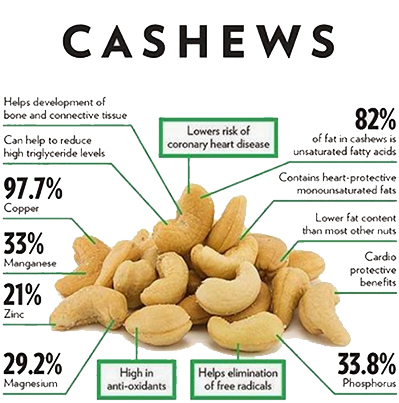
Nutrition Facts
Serving Size: 100gm
Amounts per servings
*Percent Daily Values are based on a 2,000 Calorie diet.
Facts on Cashew Nuts
The cashew tree (Anacardium occidentale) is a tropical evergreen tree that produces the cashew nut and the cashew apple. It can grow as high as 14 m (46 ft), but the dwarf cashew, growing up to 6 m (20 ft), has proved more profitable, with earlier maturity and higher yields.
The species is originally native to northeastern Brazil. Portuguese colonists in Brazil began exporting cashew nuts as early as the 1550s. Major production of cashews occurs in Vietnam, Nigeria, India, and Ivory Coast.
The cashew nut, often simply called a cashew, is widely consumed. It is eaten on its own, used in recipes, or processed into cashew cheese or cashew butter. The shell of the cashew seed yields derivatives that can be used in many applications including lubricants, waterproofing, paints, and arms production, starting in World War II. The cashew apple is a light reddish to yellow fruit, whose pulp can be processed into a sweet, astringent fruit drink or distilled into liquor.

